
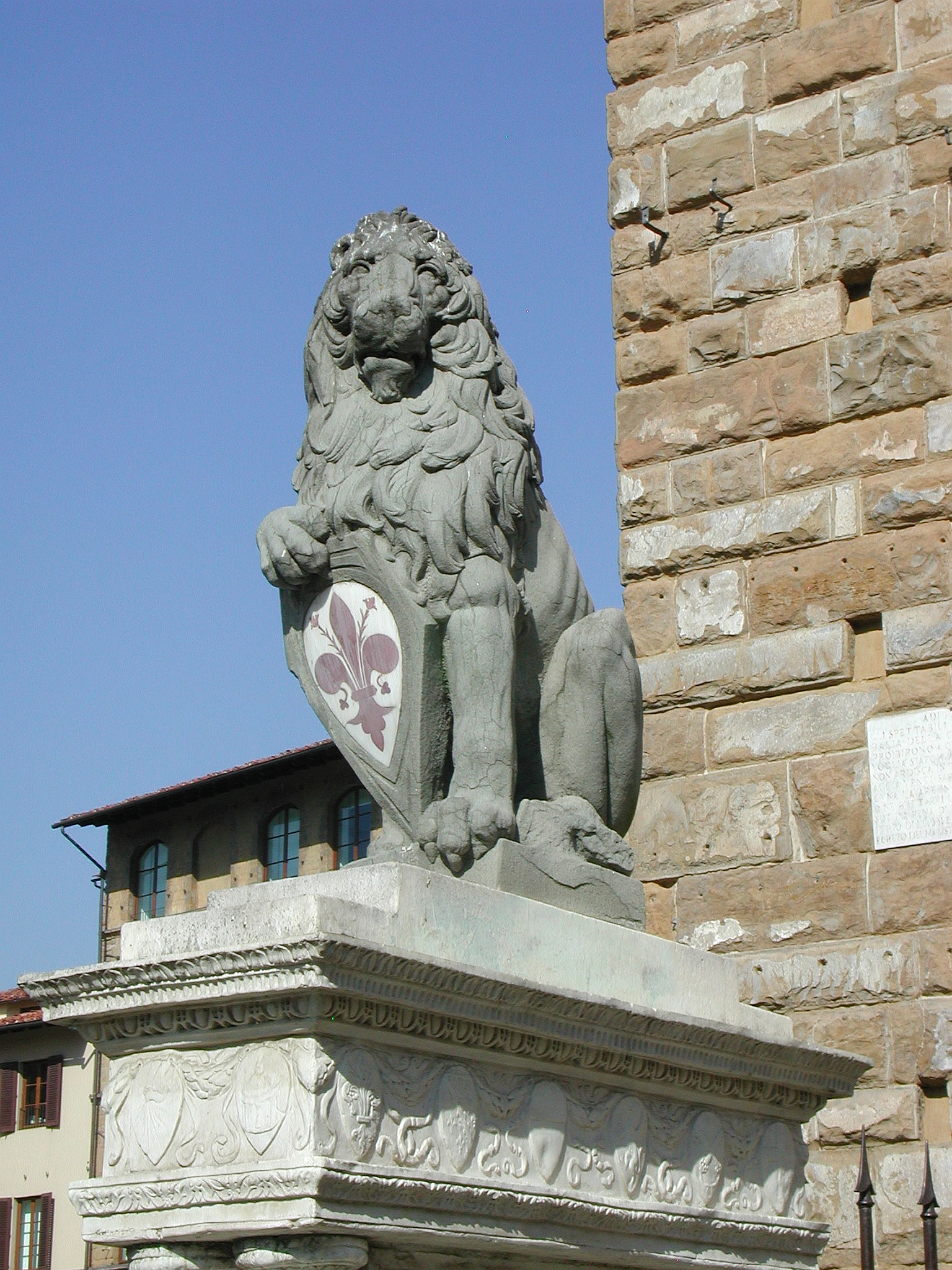
The Marzocco in Piazza della Signoria, a copy of Donatello’s original. Photo: Riccardo Speziari, CC BY-SA 3.0, via Wikimedia Commons.
The Lions of Florence, an exhibition at Palazzo Vecchio
When: 27 October 2026 – 18 January 2027
Where: Sala dei Gigli, Museo di Palazzo Vecchio
For centuries, the lion has stood as the symbolic guardian of Florence, embodying the city’s strength, independence and civic power. Its image runs throughout the city’s history, from the sculptures that watch over its squares and palaces to the decorative features of its public buildings, eventually becoming one of the most recognisable emblems of Florentine identity.
This figure, and its profound connection with the city’s political, artistic and cultural history, is the subject of The Lions of Florence, an exhibition hosted in the Sala dei Gigli at the Museo di Palazzo Vecchio from 27 October 2026 to 18 January 2027.
The exhibition is promoted by the Municipality of Florence / Florentine Civic Museums and organised by Fondazione MUS.E. It is curated by Carlo Francini and Valentina Zucchi and presented in collaboration with GAMB / Galleria dell’Accademia di Firenze and the Bargello Museums.
The exhibition invites visitors to rediscover the lion not merely as an artistic and decorative subject, but above all as a symbol through which Florence has shaped and expressed its identity over the centuries. This story finds its most significant expression in the Marzocco, the lion that symbolises the Florentine Republic and embodies sovereignty, freedom and civic dignity.
The exhibition and the story of the “living” lions of Palazzo Vecchio
Until 18 January 2027 · Sala dei Gigli · Museo di Palazzo Vecchio, Piazza della Signoria
It is no coincidence that the exhibition is centred around Palazzo Vecchio, the historic seat of the city government and a privileged setting for the representation of civic power. The Sala dei Gigli, one of the palace’s most emblematic rooms, thus becomes an integral part of the narrative. The exhibited works engage in a dialogue with the architecture, decorative elements and leonine imagery already present in the room, revealing how, over the centuries, the lion became a powerful means of political communication and a symbol through which the city represented itself.
Through sculptures, paintings, artefacts and documents, the exhibition brings together works and historical testimonies from different periods, spanning from the Roman era to the modern age, and conveying the richness of meanings that this figure has acquired over time.
Visitors are welcomed by two monumental lion-head sculptures (protomi leonine) by Baccio d’Agnolo, on loan from the Museo di San Marco. They are accompanied by two further Marzocco lions, dating from 1383 and attributed to Jacopo di Piero Guidi and Francesco Neri, known as il Sellaio, also from the same museum. The exhibition also features a bronze replica of the Marzocco, created by Clemente Papi for Piazza della Signoria and belonging to the civic collections; a detached fresco depicting a lion and a lily from the convent of Santissima Annunziata; and the painting Lion in Two Views, attributed to Bartolomeo Bimbi.
The exhibition also includes works and documents illustrating the widespread presence of leonine imagery in Florentine art and culture. Among these are the magnificent illuminated antiphonary belonging to the Opera di Santa Maria del Fiore and the celebrated Specchio umano from the Biblioteca Medicea Laurenziana; an eighteenth-century map by Ferdinando Ruggieri, held in the Historical Archives of the Municipality of Florence, documenting the city’s lion enclosure; and a lithograph by Adolfo de Carolis, once again dedicated to the Marzocco, from the Museo Nazionale Salce in Treviso.
Real lions in the heart of Florence
Alongside its artistic and symbolic dimension, the exhibition explores a particularly fascinating aspect of the city’s history: the presence of living lions in Florence dating back to the Middle Ages. Exotic and fearsome animals, lions were kept in menageries that served as striking displays of prestige and authority.
After being housed in Piazza San Giovanni and at the Palazzo del Podestà, a menagerie was established within Palazzo Vecchio itself from the mid-fourteenth century until 1550, further strengthening the association between the lion and the city’s government. Indeed, the street behind the palace is still known today as Via dei Leoni. The same name was also given to what is now Via Cesare Battisti when the menagerie was relocated there.
Historical chronicles recount the presence of numerous lions kept in the very heart of Florence’s institutional life. Their presence inspired wonder and made the power of the Republic tangible. The records also document hunts and animal fights organised on important ceremonial occasions for the city, as illustrated by a drawing by Giovanni Stradano included in the exhibition and loaned by the Prints and Drawings Department of the Uffizi Galleries.
Bringing this remarkable story to a close, the exhibition presents an exceptionally rare specimen: a taxidermied lion from the Natural History Museum of the University of Florence.
Our tip: go lion hunting with a sketchbook
After the exhibition, step outside and keep looking. Start with the Marzocco in Piazza della Signoria, then walk round the back of the palace along Via dei Leoni. Lions are everywhere in Florence, on façades, fountains and coats of arms: a perfect subject for an afternoon of drawing in the city.
Opening times and tickets: please check the Museo di Palazzo Vecchio website before you go.