
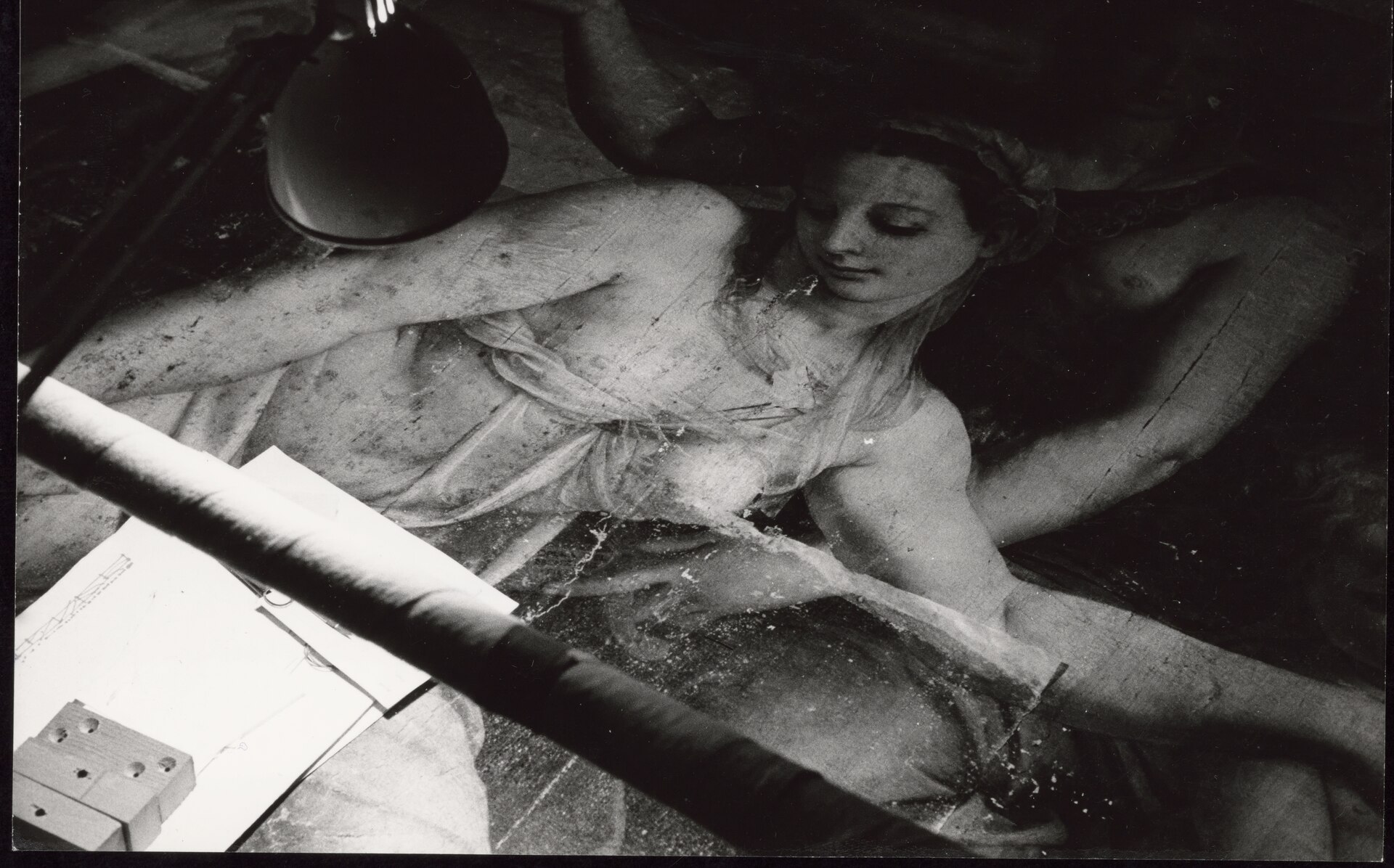
A panel painting by Bronzino from the Basilica of Santa Croce under restoration in the “hospital for paintings” set up in the Limonaia of the Boboli Gardens, February 1967. Photo: UNESCO / Dominique Roger, CC BY-SA 3.0 IGO, via Wikimedia Commons.
Florence, 4 November 1966. A city submerged in water, a cultural heritage under threat, and a generation of young people ready to make history.
On 4 November 1966, the Arno River overflowed its banks, flooding the streets of Florence and leaving behind a scene of unimaginable devastation. Mud, water and destruction swept through one of the world’s most extraordinary cities, threatening centuries of art, history and human creativity.
But from the mud emerged something extraordinary: a powerful expression of solidarity, courage and humanity.
They were the Angeli del Fango, the Mud Angels
They came from all over Italy and from many different countries. They were students, young people, volunteers, artists and ordinary citizens. They had no special equipment, no grand plans and often no idea of the scale of the disaster awaiting them. Yet they came, driven by one simple desire: to help.
With their bare hands, they worked tirelessly to rescue books, manuscripts, paintings and precious works of art from the mud. They entered flooded libraries, churches, museums and historic buildings, carefully carrying away fragments of a heritage that belonged not only to Florence, but to the entire world.
Their work was exhausting, dirty and often dangerous. They spent hours covered in mud, surrounded by destruction, knowing that every rescued book, every recovered document and every saved artwork represented a small victory against oblivion.
They were young, but their actions revealed a maturity and generosity that transcended generations.
More than volunteers: guardians of memory
The Mud Angels did much more than help clean a flooded city. They helped preserve its soul.
Florence was not simply a place filled with beautiful buildings and priceless masterpieces. It was a living symbol of human creativity, knowledge and cultural identity. By saving its artistic and historical treasures, the volunteers were protecting a legacy shared by humanity.
Their contribution became a symbol of international solidarity and demonstrated that culture is not the property of a single city or nation. It belongs to everyone, and its preservation is a collective responsibility.
The beauty that rose from the mud
Sixty years later, the story of the Mud Angels continues to move us.
It reminds us that, in moments of catastrophe, humanity can reveal its most beautiful qualities. When institutions and resources are overwhelmed, people can still make a difference through compassion, determination and the willingness to stand together.
The Mud Angels did not seek recognition. They simply answered a call for help.
Perhaps that is what makes their story so powerful: they remind us that heroism does not always wear a uniform, carry a title or make headlines. Sometimes, it looks like a young person covered in mud, holding a damaged book with extraordinary care.
A tribute that must never fade
Today, Florence still carries the memory of that terrible November. But alongside the memory of destruction lives another, brighter memory: that of thousands of hands working together to rebuild hope.
To the Mud Angels, wherever they may be today, we offer our deepest gratitude.
You came as strangers and left as part of Florence’s history. You helped save not only works of art, but the memory, identity and dignity of an entire city.
You were angels without wings, heroes without medals, and guardians of a heritage that belongs to us all.
And as long as Florence remembers, the Mud Angels will never disappear. Because some of the greatest works of art are not paintings or sculptures. They are the acts of humanity we leave behind.
They came to rescue Florence from the mud. Instead, they left the world a timeless lesson in humanity.